Pillar 2
Blended Finance Facilities for Decarbonisation and A&R
Technological advances have made sustainable infrastructure increasingly viable, yet access to affordable, long-term capital remains a key barrier. SGFIN’s Pillar 2 focuses on developing blended finance frameworks that mobilise public, private and philanthropic capital to de-risk and scale high-impact decarbonisation and resilience projects. By aligning diverse investor motivations and designing optimal financing structures, the work seeks to unlock funding for underfinanced sectors and drive innovation in sustainability-linked financial products.
SGFIN research on blended finance examines how such approaches can accelerate decarbonisation and strengthen climate resilience, focusing on practical frameworks and instruments for de-risking investments, enabling energy transitions, supporting climate-resilient infrastructure, and expanding access to sustainable finance across diverse stakeholders.

Tapping ASEAN’s Renewable Energy Potential Through Capital Markets
Impact Valuation of Energy Transition Projects in Asia: 2013-2022
Vigilia Ang Sher Wen | Desmond Tay Zhi Yuan | Weina Zhang
This whitepaper aims to evaluate the impact of energy-transition projects in Asia using appropriate financial proxies to establish an assessed value that allows projects to be compared across sectors and industries.
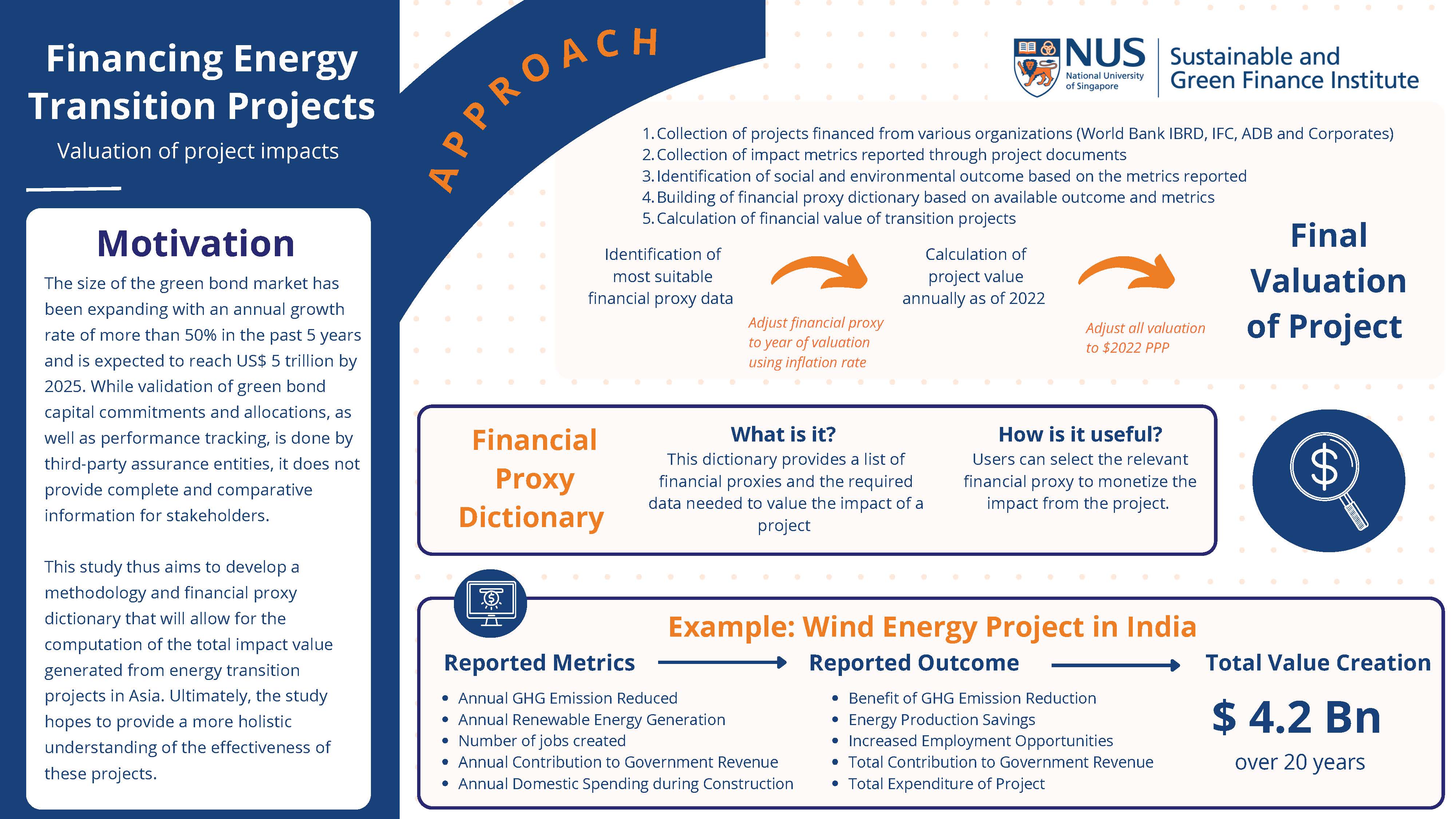
This is a study on the methodology and computation of the total impact value generated from various Energy Transition Projects implemented in Asia Pacific. The validation of these capital commitments and allocation, as well as their performance, is usually done by a third-party assurance entity. However, this process does not guarantee the complete reflection of social and environmental impacts. The use of financial proxies as a translation of impacts would facilitate a better comparison of different impacts generated by different green projects and allow for a more holistic value creation expressed in terms of the return on investment (ROI). This will be useful for various stakeholders (e.g. Policymakers, investors, or NGOs) when making investment decisions.
The key contribution of this research is to establish a holistic integrated valuation framework that facilitates the computation of the Integrated Return on Investment (IROI) of each energy transition project. The new methodology will provide the monetization of different impact metrics of various green projects for the ease of comparison across time and geographical locations, facilitating a more efficient investment decision process in the context of sustainable development in energy transition in different Asian countries.
Read our whitepaper below:
Energy Transition: Enabling Singapore Small and Medium Enterprises to Go Solar
20 February 2024, IVEY Case No. W34499
Green Consultant, a Singapore-based environmental consulting firm, had worked with several financial institutions before 2023 and was aware that many were interested in expanding their loan portfolios to include more environmentally inclined clients. In January 2023, one such client, a Singapore-based small and medium enterprise (SME) named Chang & Lee Manufacturing (CLM), approached Green Consultant to prepare a business proposal on how the SME could transition to solar energy. A green finance analyst at Green Consultant had one month to deliver a proposal to CLM. He had to consider the type of solar business model, the financing option, and the CLM stakeholders to engage, alongside CLM’s operational and financial conditions, to recommend the most economically feasible solar solution for CLM. This case will allow students to: 1) Compare the major business models for solar energy adoption and quantitatively evaluate the benefits and costs of each model; 2) Understand the financing options for solar energy adoption in Singapore; 3) Apply financial valuation models to solar energy projects; 4) Set up a general decision tree for solar energy adoption.
WaterEquity: Alternative Investment
22 June 2020, IVEY Case No. 9B20N016
In September 2018, WaterEquity, a US-based investment vehicle had to raise US$50 million in capital to provide clean water solutions for billions of people in four developing countries—India, the Philippines, Indonesia, and Cambodia. Through the lending facilities of the local microfinance institutions, WaterEquity could offer support to the poor and empower more women, generating both financial and social returns. The sales team had to propose sales pitches for alternative investments for three types of investors (foundations, endowment, and investment banks). Students need to: 1) apply the Markowitz efficient frontier analysis and optimal portfolio allocation models to real-time market data; 2) describe the effect of diversification on portfolio risk and return; 3) delineate the differences between financial and social returns; and 4) rationalize an investment strategy recommendation when standard utility functions are modified.