
Tariffs Test Southeast Asia’s Clean Energy Exports
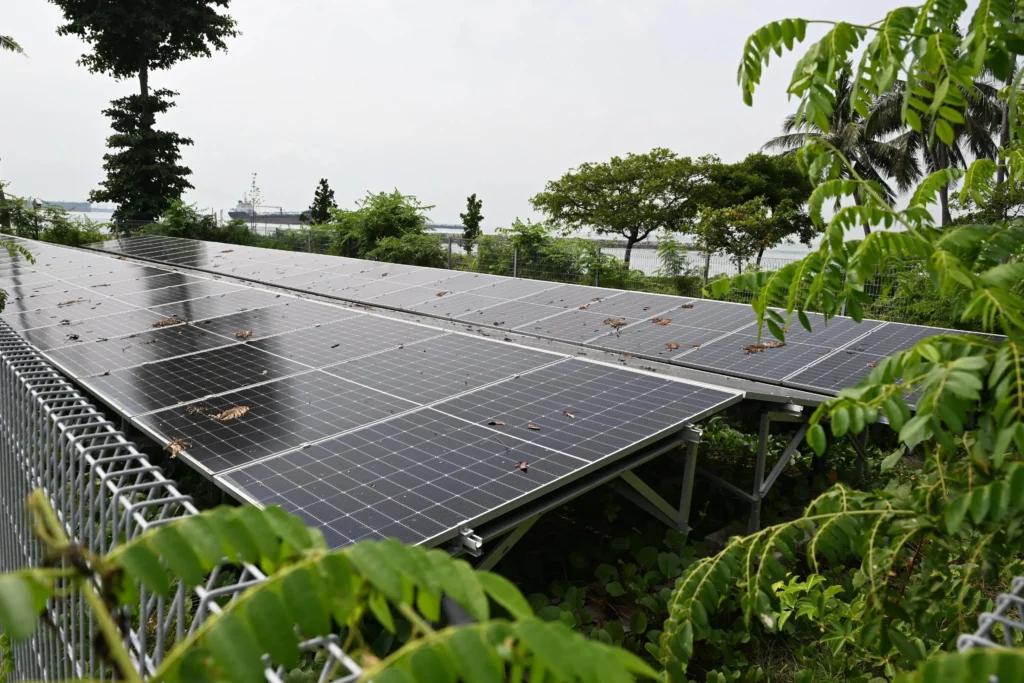
In two recent Business Times (BT) articles, Professor Johan Sulaeman, Director of SGFIN, commented on the effects of US punishing tariffs on Southeast Asian manufacturers in the renewable energy sector.
In a BT article titled “Greater ASEAN integration could prevent tariff-induced slowdown in energy transition: observers”, Professor Johan Sulaeman discussed the impact of U.S. tariffs on electric vehicle (EV) supply chain exports from Malaysia and Thailand. He noted that while these exports face lower duties compared to solar products, the tariffs still affect the countries’ ability to remain significant players in the EV supply chain. However, he pointed out that EV-related exports from these countries maintain a competitive advantage in the U.S. market compared to those from China, whose EV exports constitute only a small fraction of the U.S. market despite being the world’s largest EV exporter.
Complementing these observations, another BT article titled “US punishing tariffs put South-east Asian solar exporters in China-plus-one strategy bind” featured Professor Johan Sulaeman’s comments on the broader implications of the U.S. tariffs on Southeast Asian solar exporters. He explained that these tariffs disrupt the “China-plus-one” strategy, where companies diversify manufacturing beyond China to Southeast Asia. The tariffs undermine this strategy by targeting Southeast Asian countries, thereby affecting their role in global supply chains.
Overall, Professor Johan Sulaeman emphasized that while Southeast Asian countries have benefited from supply chain diversification strategies, the imposition of U.S. tariffs poses significant challenges to their clean energy export sectors, particularly in solar and EV industries.
Who Will Pay For A Sustainable World, And Who Will Gain?
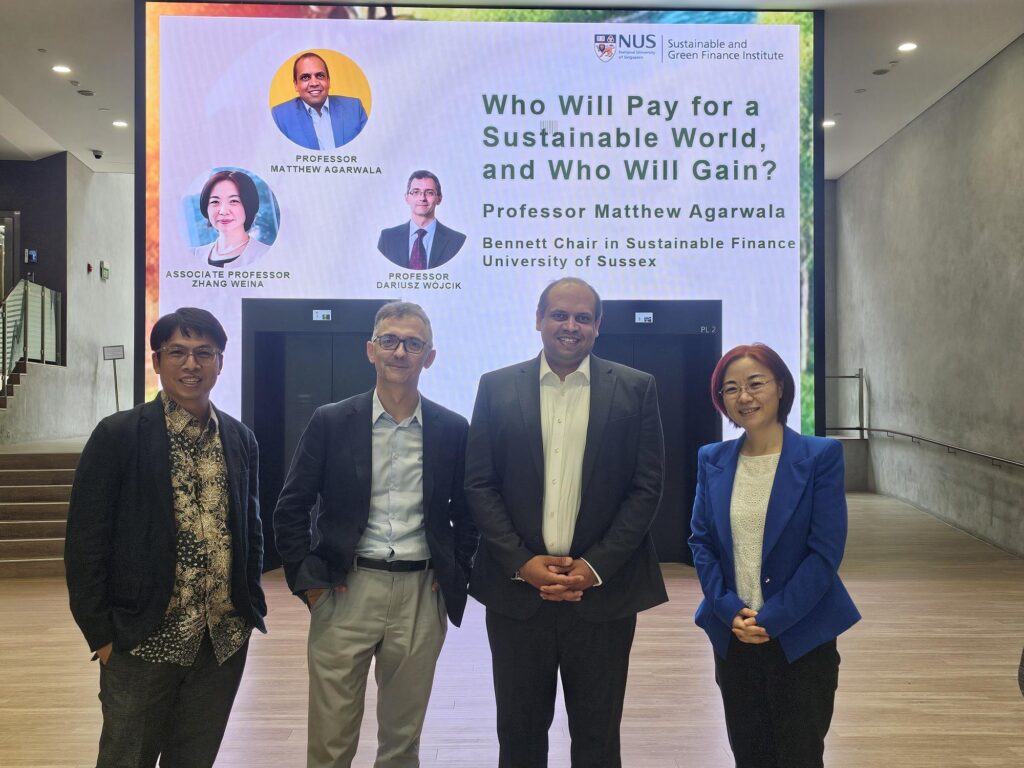
We were honoured to host Professor Matthew Agarwala, Bennett Professor of Sustainable Finance at the University of Sussex, for an insightful lecture on the vital role of nature in shaping the future of finance and economic development. He advocated for a new economic model that moves beyond GDP to include natural, human, social, and institutional capital, warning that continued environmental neglect risks mispricing assets and risks. Professor Agarwala presented his team’s innovative, data-driven framework for environmentally adjusted credit ratings to better reflect ecological realities, especially for vulnerable developing nations. A lively panel discussion with Professors Dariusz Wojcik and Zhang Weina emphasized the urgent need to rethink growth, invest in inclusive, long-term wealth, and improve funding mechanisms for small-scale, high-impact projects, particularly in Asia.
Incorporating Standard Disclosures into Carbon Credits Project
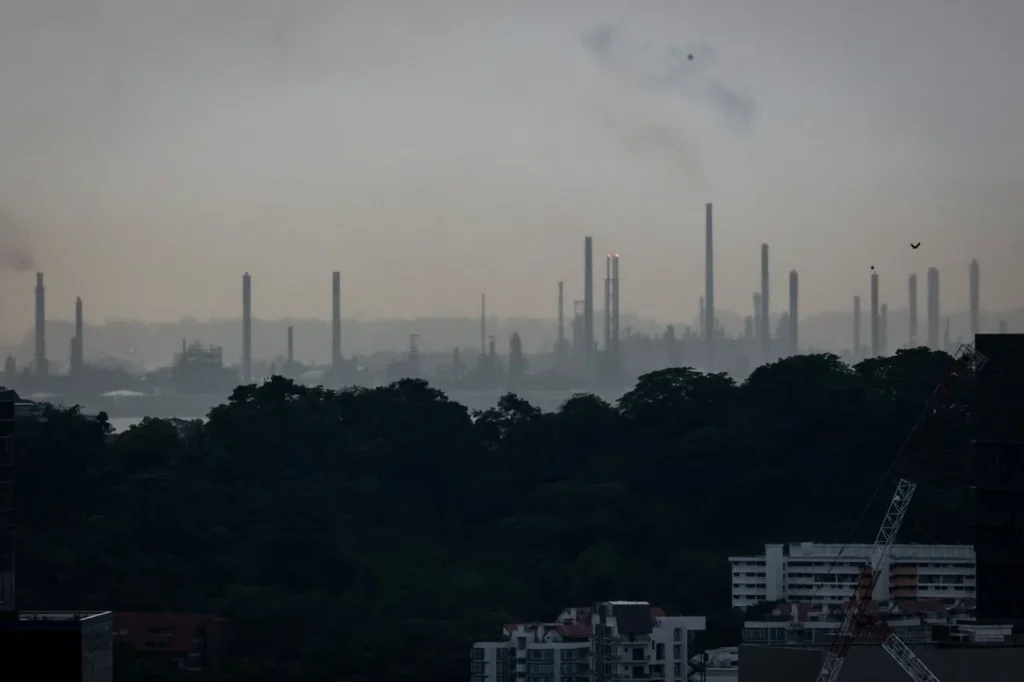
As the global demand for carbon credits continues to grow, so does the debate surrounding their actual impact. Questions remain over whether carbon credits truly deliver the environmental and economic benefits they promise—and how risk is effectively factored into their pricing remains a grey area for many stakeholders.
Our opinion piece, published through The Business Times, draws attention to the quality risks financiers and governments take on when supporting carbon projects. It highlights a pressing need for more robust project selection processes, supported by standardized frameworks. This is especially critical for countries like Singapore that are scaling up their carbon credit purchases to meet their Nationally Determined Contribution (NDC) targets.
To help chart a path forward, SGFIN released a whitepaper last year, offering an approach for evaluating carbon credit quality. The report breaks down the core pillars of a high-integrity carbon crediting framework, detailing both the essential requirements, and supporting criteria that enable carbon credit frameworks to align with the best practices out there. As the industry moves toward greater accountability and transparency, approaches like these are key to unlocking trust and scaling climate finance in a meaningful way.

Singapore Banks Flagged for Financing Harita’s Coal-Powered Nickel Smelters
In a recent Business Times (BT) article, Singapore’s three major local banks—OCBC, UOB, and DBS—have been named in a report by environmental group Market Forces for financing Indonesia’s Harita Group, whose nickel smelting operations are powered primarily by coal. OCBC led with US$635 million in loans since 2018, followed by UOB (US$201 million) and DBS (US$87 million). Even though all three Singapore banks have committed to cease the financing of new coal-fired power plants, financing the production of nickel does not fall under this remit even if the extraction activities are powered by coal.
Given the dominance of coal in Indonesia’s energy supply, banks are arguably caught between a rock and a hard place as their financing are limited by the constraints of the external environment they operate in. Associate Professor Zhang Weina, Deputy Director of SGFIN, offers her comments on the matter: While terminating financing for all carbon-intensive projects may not be practical, especially for transition-critical sectors like nickel mining, banks can take measured steps.
This article sheds lights on some recommendations on how to address the sustainable issues arisen from Asian EV battery producers.

Centre for Liveable Cities | Regenerative City Forum
A/Prof Zhang Weina was invited by the Centre for Liveable Cities (CLC) to present at the Regenerative City Forum workshop on 14 Mar 2025, which focused on “Enabling and Scaling Regenerative Design for Singapore.” She introduced SGFIN’s Integrated Return on Investment (IROI) framework, which measures Economic, Environmental, Social, and Governance (EESG) factors by considering interlinked designs, co-benefits, and externalities through causal relationships. The adaptable IROI approach, tailored to various stakeholder interests, was well-received by the audience. SGFIN researchers also joined group discussions to explore regenerative design for hypothetical sites, contributing to a rich exchange of insights across diverse sectors.

Government backing and geopolitical stability key to achieving Singapore’s climate targets
Singapore’s 2035 climate targets are achievable but pose significant challenges amid geopolitical uncertainties, experts say. Meeting the emissions reduction goal will require strong government support, international cooperation, and advancements in emerging technologies such as green electricity imports and carbon capture. However, the transition may drive up energy costs, potentially sparking public resistance. Several experts, including SGFIN’s Dr David Broadstock, shared their views on the issue.
CBET Thematic Workshop
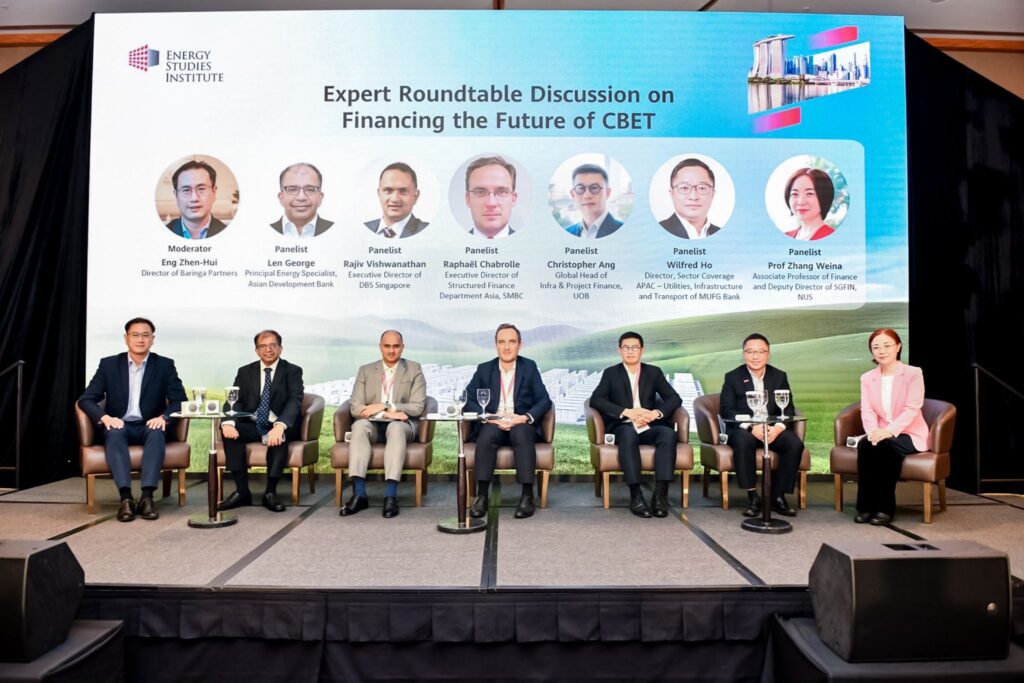
On 17 Jan 2025, A/Prof Weina Zhang presented the findings on the impact valuation of energy transition projects in Asia at the Cross Border Electricity Trading Thematic Workshop. She shared the Integrated Return on Investment methodology, which assessed >350 green bond-financed projects based on economic, environmental, and social impacts. The findings revealed the pivotal roles played by multilateral development banks in more developing countries as well as attracting more private capital. Moreover, there is also room for improvement for corporate issuers in making more disclosures in the impact achieved. In the follow-up panel discussion on financing cross-border electricity trade, she also highlighted the importance of stakeholder collaboration to close funding gaps and mitigate risks together.
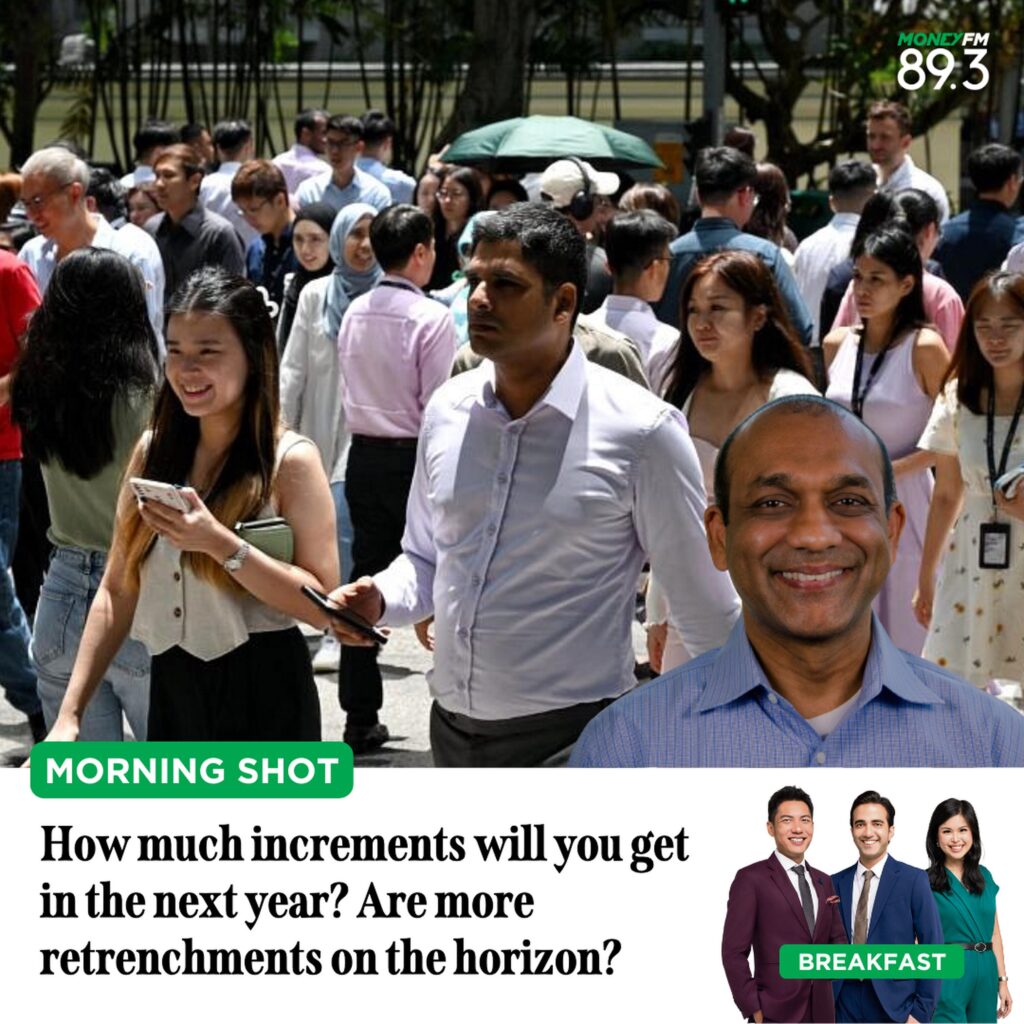
Recommendations by National Wages Council on Fair and Sustainable Wage Increase
Taking into account the sustained productivity growth, improved economic outlook, and expected moderation in inflation in 2024, the National Wages Council has recommended for fair and sustainable wage increments for workers. Prof Sumit Agarwal, Managing Director of SGFIN and Professor of Finance, Economics, and Real Estate at NUS Business School, shared his thoughts on this subject with Money FM 89.3.
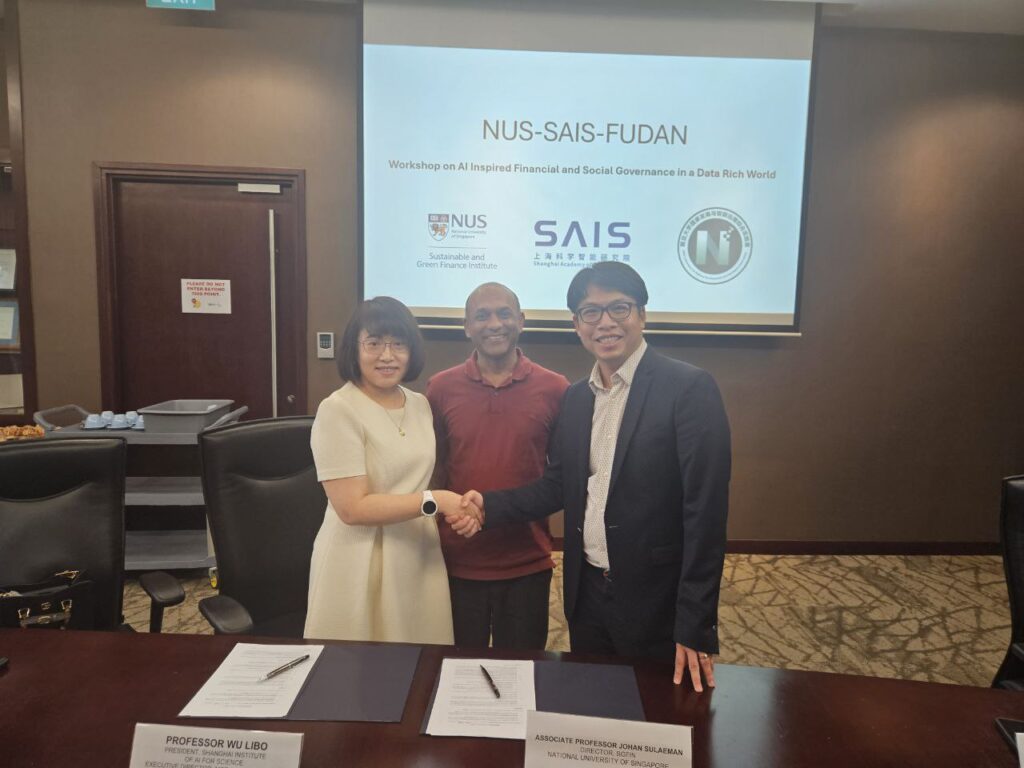
Memoranda of Understanding with MOE Laboratory for National Development and Intelligence Governance and Shanghai Academy of AI for Science
SGFIN recently signed two Memoranda of Understanding (MOUs) with the MOE Laboratory for National Development and Intelligence Governance (NDIGL) at Fudan University and the Shanghai Academy of AI for Science (SAIS). These collaborations aim to explore research projects on sustainable finance, AI, and big data, as well as to develop interdisciplinary educational programs that integrate AI with sustainable finance, enhancing the quality and consistency of sustainability data in the Asian context. The signing ceremony was accompanied by a workshop where both NUS and Fudan University researchers presented their research on these critical topics. These partnerships mark a significant step forward in advancing sustainable finance through data-driven, evidence-based, interdisciplinary research.
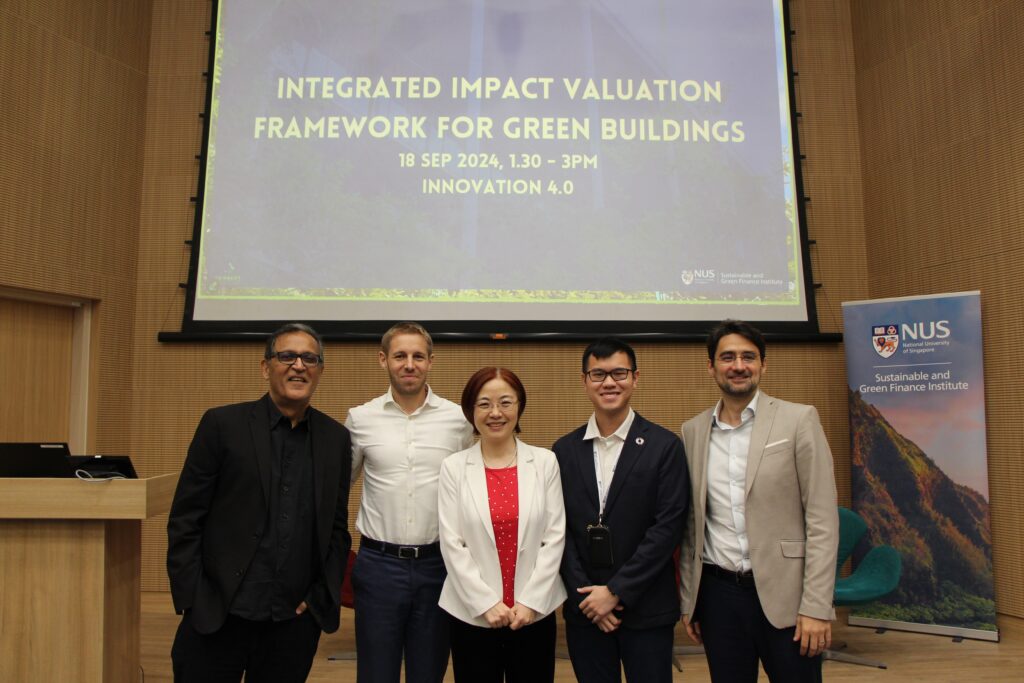
Launch of Integrated Impact Valuation Framework for Green Buildings
On 18 Sep 2024, SGFIN unveiled its whitepaper, “Integrated Impact Valuation Framework for Green Buildings,” at an event featuring industry and academic leaders. Prof Zhang Weina provided a comprehensive overview, highlighting the whitepaper’s holistic framework which integrates 13 established building standards and utilization of the IROI (Integrated Return on Investment) methodology, which evaluates economic, environmental, social, and governance (EESG) factors alongside traditional financial metrics. The panel discussion that followed further underscored the critical role of policy changes and societal recognition of sustainability in maximizing the framework’s potential impact.
Symposium on Innovative Environmental Solutions for Accelerating the Low-Carbon Transition
On 17 Sep 2024, the NUS Environmental Research Institute (NERI) hosted the hybrid Symposium on Innovative Environmental Solutions for Accelerating the Low-Carbon Transition, as part of NUS Sustainability CONNECT Highlight. The event featured key innovations from NUS researchers and partners and emphasized the importance of collaboration in turning innovative ideas into scalable solutions for a sustainable future. Prof Johan Sulaeman, Director of SGFIN, presented SGFIN’s contributions, namely the Corporate Carbon Footprint Assessment, ESG Data Primer and Sustainability Data Integrity projects. Notably, he had addressed similar topics at the Lee Kuan Yew School of Public Policy Festival of Ideas 2024.
Brown Bag Lunch Talk: An Introduction to the Social Return on Investments and Its Application to a Health Promotion Project
On 12 Sep 2024, Prof Zhang Weina delivered a presentation at Brown Bag Lunch Talk: An Introduction to the Social Return on Investments and Its Application to a Health Promotion Project, organized by the National Healthcare Group. During the session, Prof Weina explained the SROI methodology, outlined the steps for conducting an SROI analysis, and demonstrated its application in an NHG health promotion project aimed at improving the eating habits of students. To maximize impact, Prof Weina emphasized the critical need for students to be equipped with the necessary knowledge, skills, and mindset, alongside effective national scaling efforts and collaborative action from multiple stakeholders.